


Every SaaS founder and VP of Engineering running a five-to-ten-year-old software platform is hearing the same demand from boardrooms and customers in 2026: "We need AI features in this product yesterday."
When product teams ask how to add vector search, document summarization, automated workflow agents, or conversational copilots to a mature monolithic codebase, software developers often lean toward one of two extremes. Either they propose a multi-year, multi-million dollar microservices rewrite from scratch, or they hurriedly paste OpenAI API calls directly into legacy application controllers.
Both approaches carry massive risk. A complete platform rewrite stalls feature velocity for 12 to 24 months, starves current revenue-generating products of attention, and carries a historical failure rate exceeding 70%. On the flip side, bolting non-deterministic LLM calls directly into a synchronous web request pipeline creates severe performance bottlenecks, breaks role-based permissions, and exposes customer data to compliance violations under regulations like the EU AI Act.
There is a proven third path: Incremental Architectural Modernizing Legacy Monoliths via the Sidecar AI Pattern.
This guide details how leading B2B SaaS platforms successfully retrofit production monoliths with modern AI engines, preserving their hard-earned business logic, tenant isolation, and audit trails while shipping AI capabilities in weeks rather than years.
Why "Burn It Down and Rebuild" Fails for Production SaaS
When engineers evaluate legacy code, technical debt always looks worse than it actually is. Monoliths that have survived years in production contain hundreds of unwritten business rules, edge-case handlers, compliance checks, and integration quirks.
When you attempt a ground-up rebuild to become "AI-native," you aren't just writing new code, you are attempting to rediscover and re-implement every operational edge case your business spent years solving.
The True Costs of the Rewrite Fallacy:
- Revenue Paralysis: Engineering bandwidth is completely consumed by rebuilding existing functionality rather than delivering new customer value.
- Regression Vulnerability: Customer-facing SLAs, tenant data boundaries, and billing integration logic frequently break during big-bang migrations.
- Market Velocity Loss: While your team is trapped in an 18-month rewrite cycle, nimble competitors ship incremental AI enhancements and capture market share.
Unless your legacy codebase genuinely lacks the database throughput or API hooks to support async data flow, a full rewrite is an avoidable business self-injury. See our AI retrofit vs full rewrite comparison for more details.
The Sidecar AI Architecture Pattern
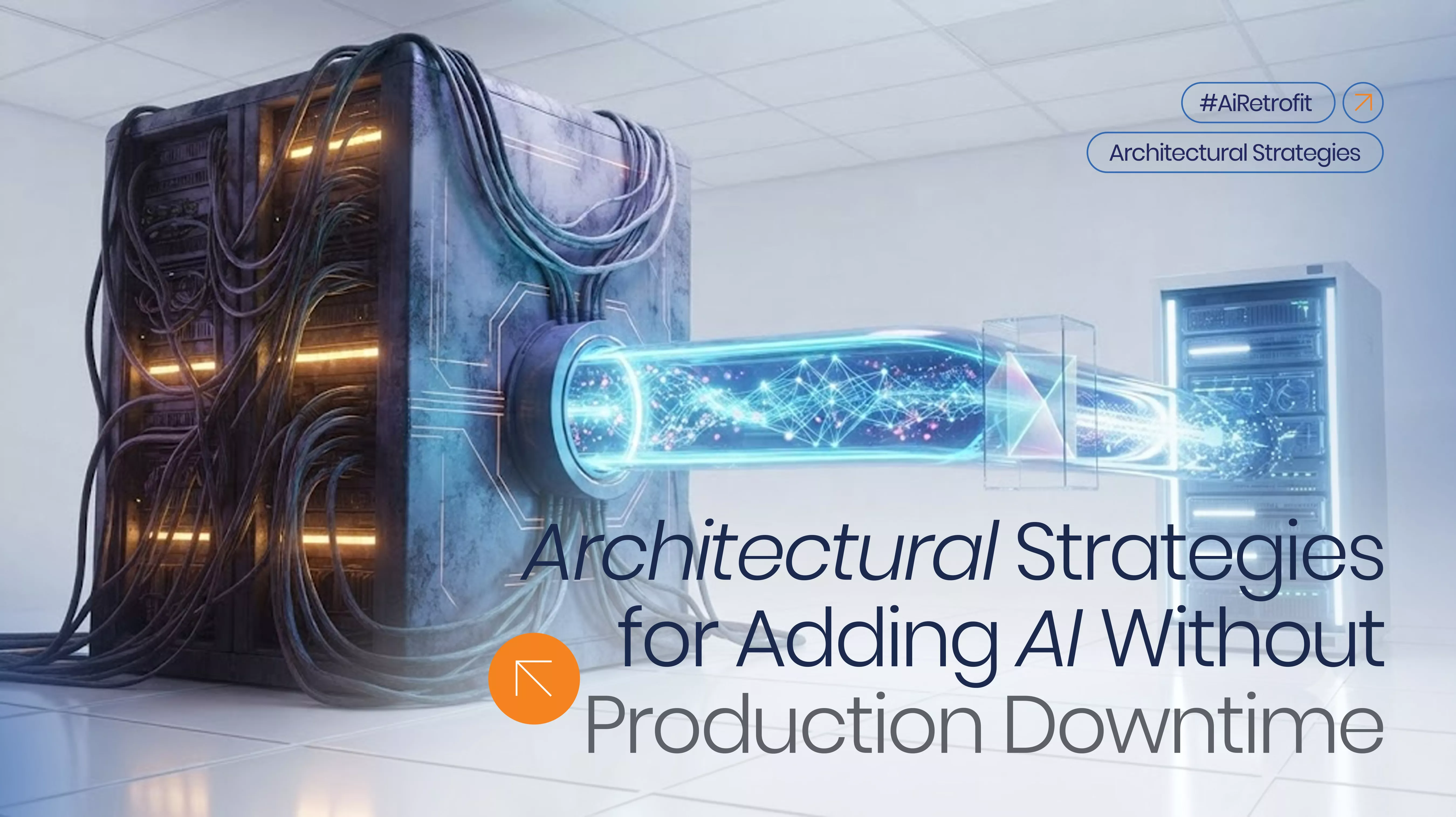
The most resilient way to modernize a monolithic SaaS application is by decoupling your AI workloads from your core transactional web server. Rather than running non-deterministic AI inference inside your monolithic application process, you deploy a dedicated Sidecar AI Orchestration Service.
The 4 Pillars of the Sidecar Architecture:
- Isolated Domain Boundaries: Identify the exact domain workflow requiring AI intervention (e.g., invoice data extraction, support ticket triage, or policy search). Keep the core domain rules inside the monolith, but delegate the intelligence processing to the sidecar.
- Asynchronous Event-Driven Execution: LLM responses can take anywhere from 1.5 to 8 seconds depending on context length and model routing. Synchronous HTTP request-response cycles inside a monolithic web server will exhaust thread pools under load. By pushing AI requests to an async message queue (e.g., RabbitMQ, Redis Streams, or AWS SQS), your monolith remains instantly responsive while the sidecar processes background intelligence.
- Model-Agnostic Abstraction Layer: Never hardcode a single AI provider's SDK into your core application. The sidecar acts as an API gateway that handles prompt templating, context retrieval, token budgeting, and fallback routing (e.g., routing fast tasks to lightweight models and complex reasoning to frontier models).
- Tenant-Aware Vector Storage: If your AI features require Retrieval-Augmented Generation (RAG), vector embeddings must inherit the exact multi-tenant filtering rules enforced by your monolith's relational database. A breach in vector context isolation is just as severe as a SQL injection vulnerability.
Real-World Case Studies: AI Modernization in Action
At Solvefy, we have applied this incremental modernization pattern across high-stakes, regulated production applications:
Case Study 1: Enterprise Healthcare Dispatch System (AICO)
Challenge: A non-emergency medical transportation platform needed voice and chat AI capabilities to automate booking and lookup queries for elderly riders.
Modernization Approach: We built an async tool-calling sidecar that interfaced directly with existing dispatch APIs (TripMaster and RMTD) without modifying the core scheduling engine on AICO Healthcare.
Results: 75% reduction in call-handling workload, achieving 98% scheduling accuracy while keeping system-of-record integrity 100% intact.
Case Study 2: Public Sector HR & Payroll Platform (IbisHR)
Challenge: An enterprise HRIS serving public-sector and enterprise clients required intelligent employee self-service and policy Q&A while maintaining strict role-based access control (RBAC).
Modernization Approach: We implemented an event-driven AI service layered over existing employee records on IbisHR, maintaining mandatory human review checkpoints for administrative actions.
Results: 60% reduction in administrative ticket volume and 95% self-service adoption within 90 days of rollout.
Case Study 3: Legal Case Management Platform (iLegal Works)
Challenge: A complex legal platform built on ASP.NET Zero needed bilingual Arabic/English document summarization and drafting under strict GCC data privacy regulations.
Modernization Approach: We architected an isolated AI module inside the existing ABP Framework security boundaries for iLegal Works, enforcing local data residency and strict audit logging.
Results: Shipped advanced AI drafting tools in 6 weeks without altering existing tenant database structures.
Compliance & Governance: Meeting the EU AI Act Standard
As of August 2026, human-in-the-loop oversight is no longer an optional engineering preference, it is a legal requirement under Article 14 of the EU AI Act for high-risk AI applications.
When retrofitting AI onto an existing SaaS platform:
- Audit Logging: Every AI execution, prompt context, and output must be logged with the same immutability as financial transactions.
- Override Mechanisms: Human operators must have explicit UI controls to modify or revoke AI-suggested actions before state mutations occur.
- Permission Mirroring: The AI sidecar must execute actions under the explicit security scope of the authenticated user, ensuring an AI agent can never access data or execute operations that the requesting user lacks permissions for.
A Step-by-Step Modernization Checklist for VPs of Engineering
Before writing code for your next AI feature, execute this audit checklist:
- Map the Data Flow: Can the AI workload operate asynchronously, or is real-time synchronous execution strictly required?
- Audit Tenant Boundaries: Does your vector database or context retrieval mechanism enforce tenant filtering automatically?
- Establish Human Checkpoints: Where does the human review step take place in the current workflow? (Preserve this step in the UI).
- Implement Model Routing: Is your architecture decoupled from specific model providers to prevent vendor lock-in?
- Pilot on a Scoped Workflow: Select a single high-impact, low-risk workflow (e.g., document summarization or smart search) before expanding across the platform.
FAQ
Is an AI retrofit always less expensive than a full platform rewrite?
Yes. A retrofit leverages the existing user authentication, database schemas, billing modules, and third-party integrations that took years to develop. Refactoring specific components via a sidecar pattern typically costs 70–80% less than a complete rebuild.
Will adding an AI layer slow down my existing monolithic database?
Not if designed correctly. By isolating vector search into a dedicated vector store (e.g., Qdrant, Pinecone, or PGVector) and using asynchronous background queues, read/write loads from AI inference do not impact transactional database performance.
How do we prevent AI agents from hallucinating incorrect data into our production database?
Enforce deterministic schema validation on all AI outputs. The AI sidecar should generate structured JSON objects that pass through traditional backend validation rules before any database write occurs.
Summary & Strategic Conclusion
You do not need to rebuild your software platform from scratch to deliver state-of-the-art AI capabilities. By implementing an asynchronous, model-agnostic Sidecar AI Architecture, B2B SaaS companies can modernize their core offerings, achieve compliance, and deliver real ROI in weeks.
Ready to modernize your legacy SaaS application?
Contact the Solvefy Engineering Team to schedule a technical architecture assessment.