


Subscription plans, invoices, and payment follow-up
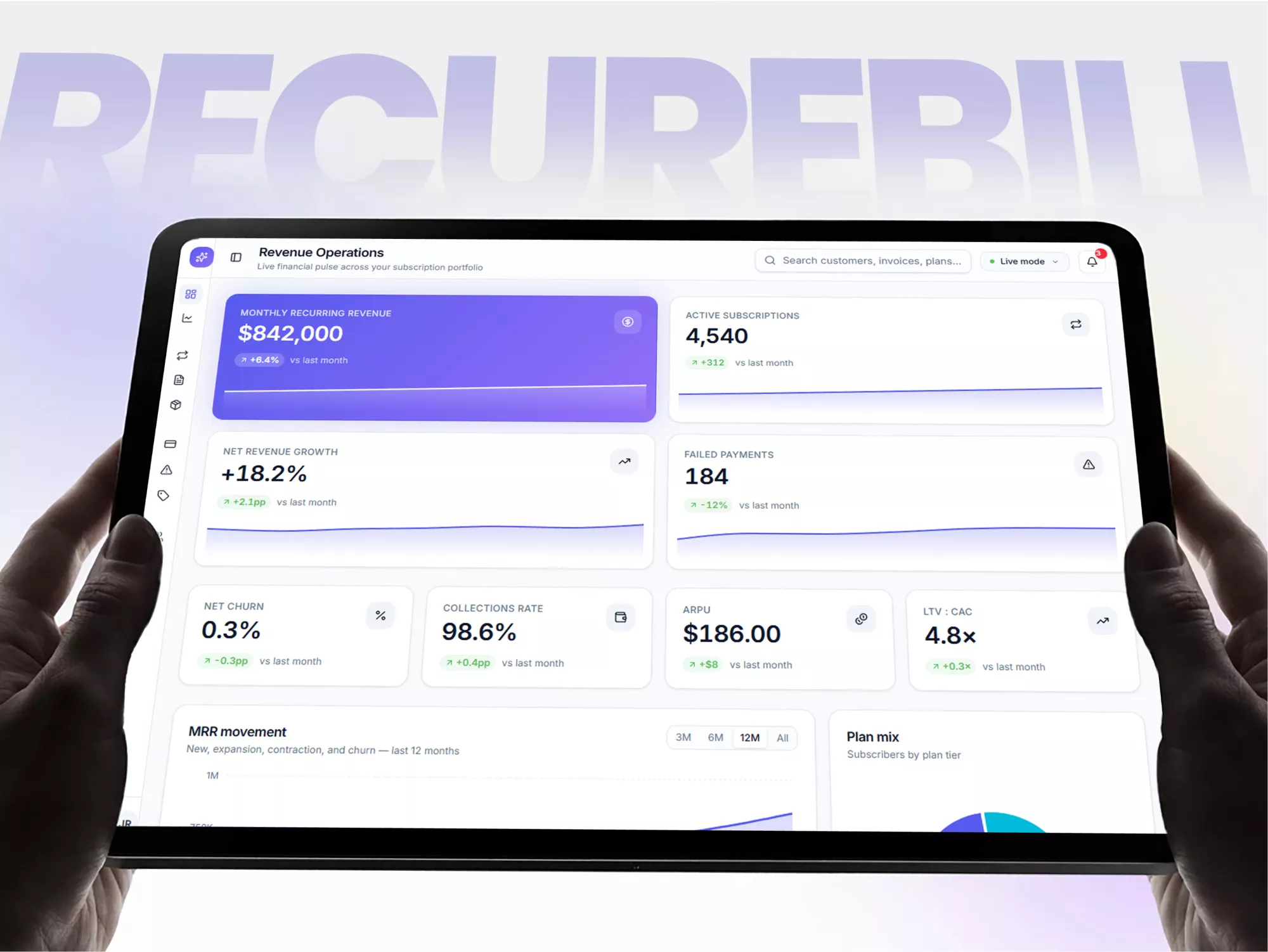
RecureBill is a subscription billing product for teams who were raising invoices and chasing failed payments by hand. Results from the delivery: 80% less billing operations effort, 70% faster invoice processing, and 50% better payment recovery.
80%
Reduction in billing operations effort
70%
Faster invoice processing
60%
Improvement in subscription management efficiency
50%
Increase in payment recovery success
The problem
Recurring billing looks simple until plans, proration, coupons, and failed cards stack up. Manual invoices miss a cycle. Dunning lives in a personal inbox. Accounts cannot see why a customer was billed.
Spreadsheets and ad-hoc emails do not store payment methods, email templates, or account history. A billing product has to sit on a stack finance can operate, here Angular, .NET Core, SQL Server, and ASP.NET Zero.
- Subscription plans and line items were hard to change without breaking the next invoice
- Invoice generation did not follow a reliable billing cycle
- Failed payments had no campaign path besides a personal follow-up
- No single place for plans, invoices, coupons, and accounts
- Email templates for invoices and dunning were not managed in product
- Payment methods were not tied to the subscription record
What we changed
We built RecureBill as a centralized recurring billing platform on ASP.NET Zero. Subscriptions, pricing, invoices, coupons, payment methods, email templates, and dunning campaigns share one account record.
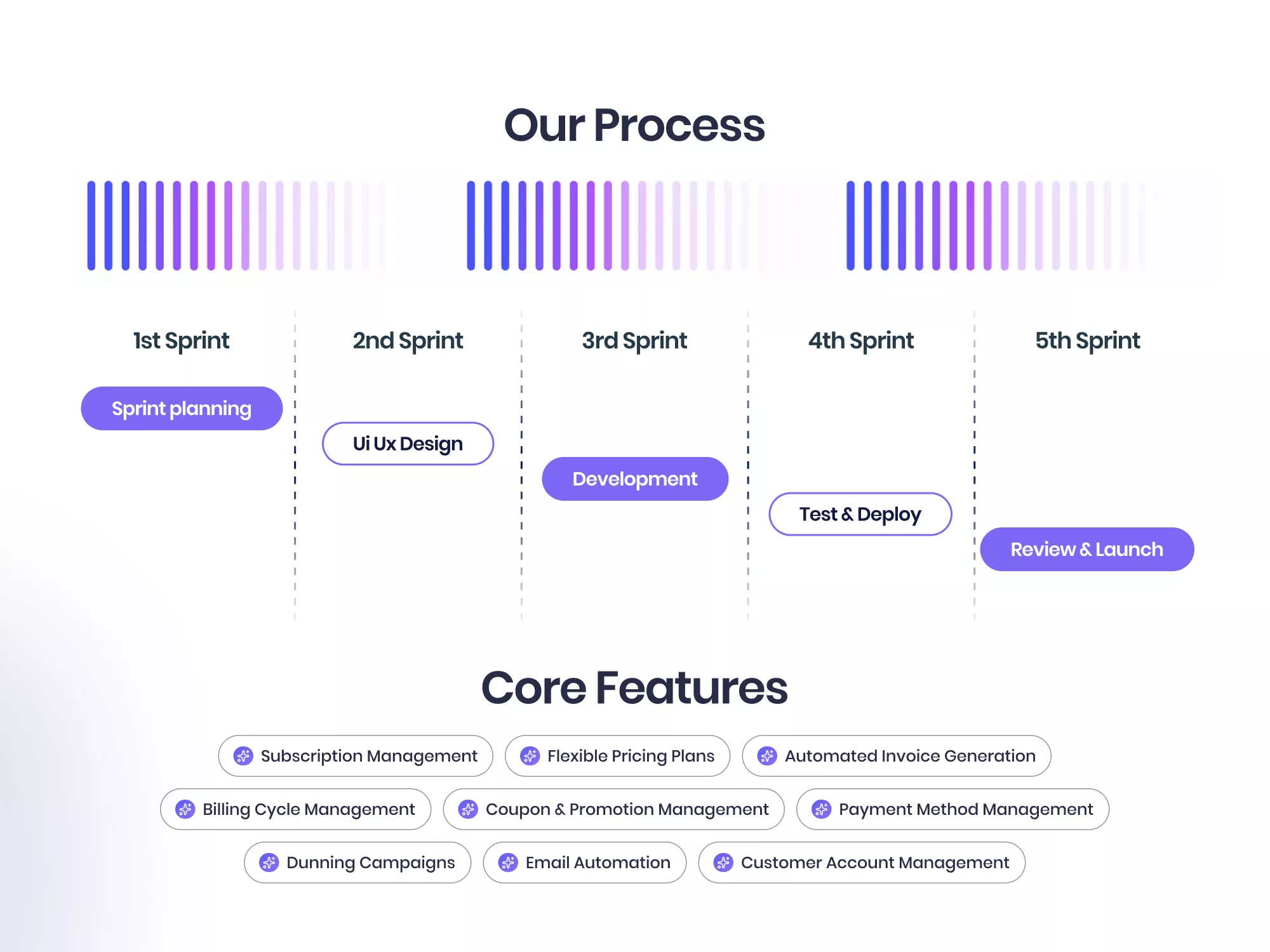
- Subscription management with flexible pricing and configurable line items
- Automated invoice generation from billing cycles
- Coupon, payment method, and email template management
- Dunning campaigns and account management
Finance still issues credits, stops a dunning campaign, and changes a plan. The product generates the invoice. A person still owns exceptions that move money.
What changed in the numbers
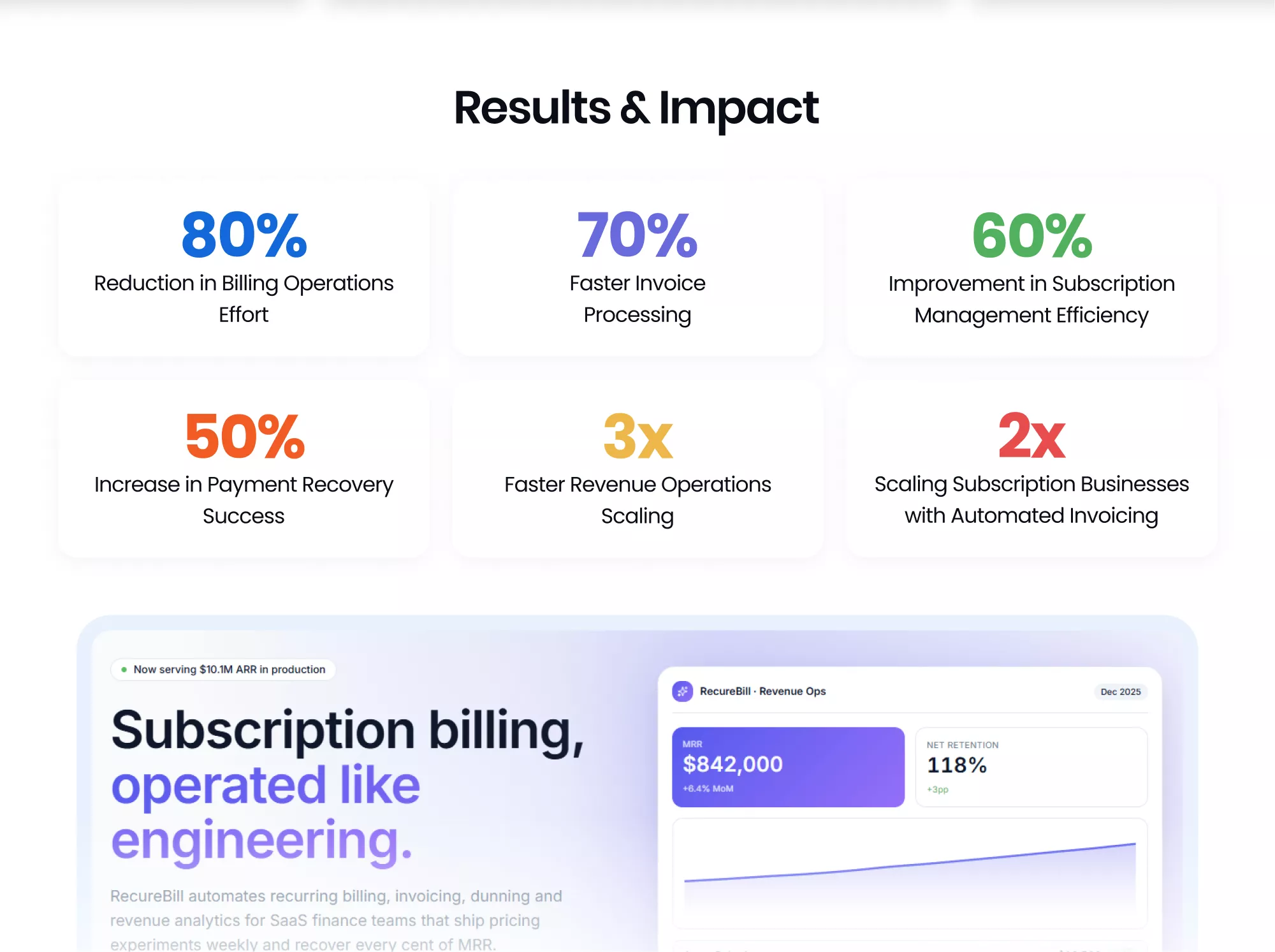
80%
Reduction in billing operations effort
70%
Faster invoice processing
60%
Improvement in subscription management efficiency
50%
Increase in payment recovery success
Billing operations effort dropped 80%. Invoice processing is 70% faster, with 50% better payment recovery.
RecureBill
What this means for you
- Recurring billing software only helps if the invoice matches the plan and the cycle
- Dunning belongs in the product, or failed payments stay in a personal inbox
- Coupons and line items need the same record as the subscription, not a side sheet
- A known SaaS stack such as ASP.NET Zero matters when finance expects audit and roles
Questions people ask
Subscription plans, billing cycles, invoice generation, coupons, payment methods, email templates, and dunning campaigns for failed or overdue payments.
Angular, .NET Core, SQL Server, Entity Framework, Clean Architecture, and ASP.NET Zero.
Finance still issues credits, changes plans, and can pause dunning. The product generates invoices on the cycle. A person still owns exceptions that move money.
Ready for a similar result?
Short assessment
Book a short assessment
We look at one live workflow and tell you whether this pattern fits, before you add another tool.
See if this fits our operationSend a note
Talk through a similar workflow
Tell us about the job your team already does. Use the form at the bottom of this page. No new login.
Talk through a similar workflowHow it works
What we chose to automate
Once cycles and invoices are reliable, later helpers can flag churn risk or suggest a dunning step. The first job is a correct invoice on the right day.
- Generate invoices from the billing cycle, not from a reminder list
- Keep dunning campaigns next to the failed payment
- Leave room for retry rules once payment data is complete
How the pieces fit together
The product uses Angular on the front, .NET Core and Entity Framework on a SQL Server store, and Clean Architecture on ASP.NET Zero so billing rules stay testable as plans change.
- ASP.NET Zero multi-tenant SaaS foundation
- Clean Architecture for billing and invoice services
- SQL Server persistence for accounts, plans, and invoices
When a person still takes over
Finance still issues credits, stops a dunning campaign, and changes a plan. The product generates the invoice. A person still owns exceptions that move money.
- Account-level control over plans, coupons, and payment methods
- Dunning campaigns that a person can pause
- Invoice history so a dispute is not guessed from email
What it connects to
- ASP.NET Zero
- Angular
- .NET Core
- SQL Server
- Entity Framework
Still raising subscription invoices by hand?
If billing cycles, coupons, and failed payments live in inboxes, we can look at putting subscriptions and dunning in one product, the way we did on RecureBill.
RELATED WORK
Related case studies, services, and guides
ASP.NET Zero modernization
Learn moreFramework modernization and governed AI retrofit for production .NET SaaS platforms.
SaaS Platforms
Learn moreWe help mature B2B SaaS teams add AI without destabilizing the product: embedded copilots, modernization layers, and framework upgrades for multitenant platforms built on .NET, ABP.IO, and ASP.NET Zero. AI retrofit for SaaS means governed automation inside the workflows you already run, with tenant boundaries, role based access, and audit trails. Whether your product serves staffing, HR, healthcare, or logistics operations, we integrate AI capabilities safely into workflow-heavy SaaS. IbisHR, Array Corp, and Workloop show multitenant proof in production.
Legacy SaaS modernization review
Learn moreWe audit your underlying application architecture, database isolation patterns, and dependency chains on .NET, ABP.IO, or ASP.NET Zero. You receive a clear parallel-track plan that upgrades framework versions and injects governed AI capabilities into your core workflows without forcing a costly complete rebuild.
IbisHR case study
Learn moreIbisHR cut HR admin work 60% and hit 95% employee self-service in 3 months. Staff request leave and update records without extra HR tickets.