


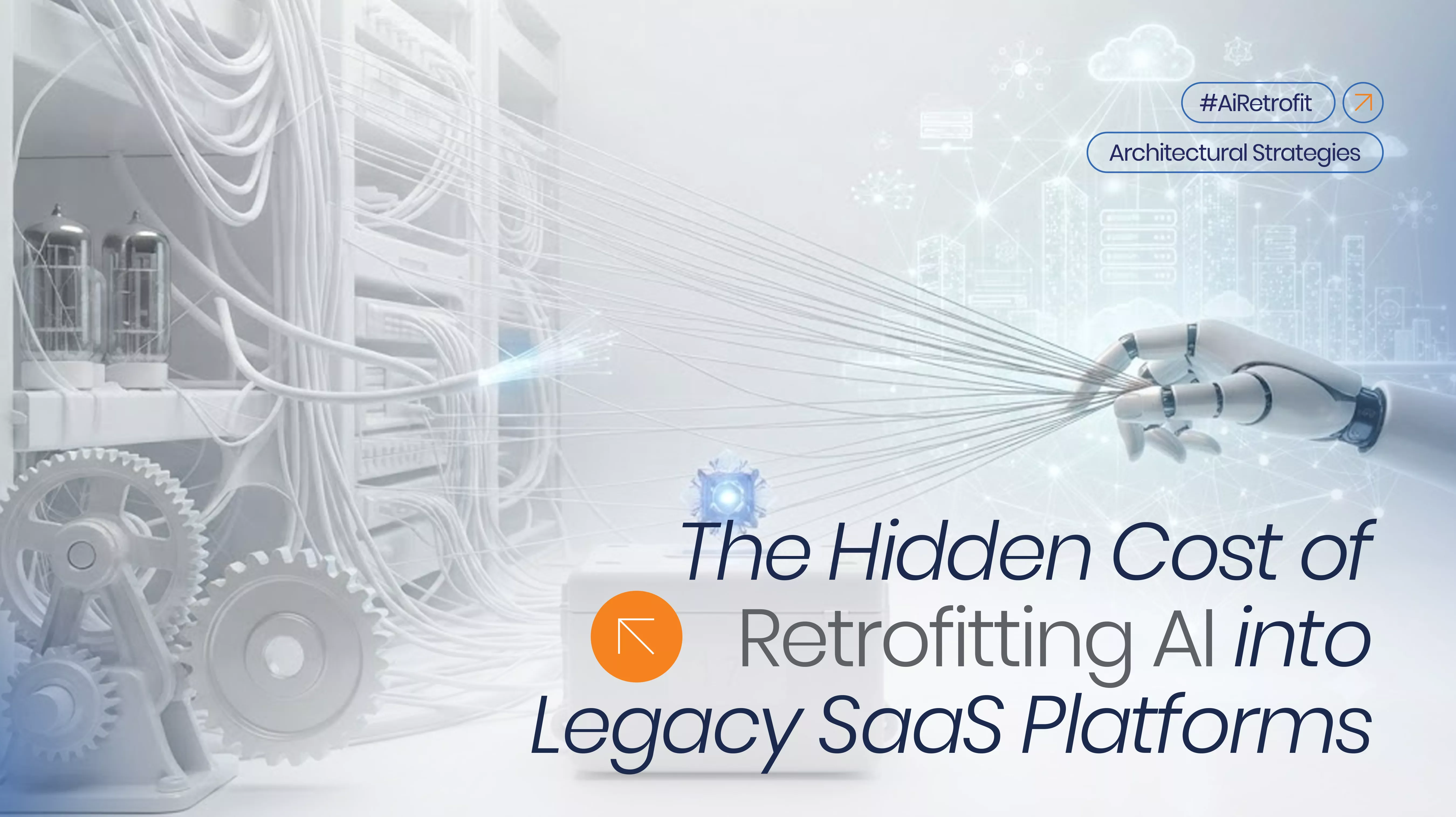
Most enterprise software teams are not starting from scratch with AI. They are inheriting systems built for a different era, designed around synchronous request-response patterns, normalized relational schemas, and tightly coupled service layers. These architectural choices made sense in 2016. In 2026, they are the primary barrier to shipping AI features that actually work at scale.
Legacy software modernization has become the defining technical challenge of this era. Organizations that cannot integrate AI into their existing platforms are losing competitive ground to newer entrants who built without the weight of technical debt. But the path forward is rarely a complete rewrite. The cost, risk, and disruption of ripping out a production system that processes real customer transactions is almost always prohibitive.
This article is for engineering leaders and CTOs navigating exactly that challenge: how to execute SaaS modernization incrementally without a full rewrite, and which architectural seams to address first to unlock your AI roadmap.
Why Legacy Architectures Struggle with AI
The core incompatibility between legacy systems and modern AI features is a mismatch in execution model. Traditional enterprise software was built for deterministic, synchronous workflows. A user submits a form. A database record is created. A success message is returned. Every step is predictable, testable, and fast.
AI inference is none of those things. LLM calls are probabilistic, variable-latency, and dependent on context that changes with every request. When you try to integrate AI into a synchronous monolithic architecture, you are forcing a probabilistic system to behave deterministically, and the architecture loses every time.
Legacy software modernization efforts that fail at the AI layer almost always share three architectural problems that become visible only under the pressure of a real AI integration attempt:
1. Thread-Blocking on Model Calls
Legacy MVC applications call services synchronously. The request thread sits open and waits for a response. For a database query that returns in 20 milliseconds, this is fine. For an LLM inference call that takes 800 to 2,000 milliseconds depending on prompt length and model load, this architecture exhausts thread pools under any meaningful concurrent user load.
The fix is not a faster model. It is an async event-driven execution layer that queues AI calls, releases the request thread immediately, and returns results through polling or a push notification mechanism. This is not a minor change. It is an infrastructure decision that affects how the entire application handles I/O. Done correctly once, it pays dividends across every future AI feature. Done as a one-off patch for a single feature, it creates a maintenance mess.
2. Schema Incompatibility with Semantic Retrieval
AI features that need context, such as document Q&A, intelligent search, recommendation engines, and workflow suggestions, require semantic data retrieval. Traditional relational databases are optimized for exact-match SQL queries. They are not designed for the nearest-neighbor vector search that semantic retrieval requires.
Organizations attempting to retrofit AI into legacy SaaS platforms frequently discover this constraint only after they have already committed to an AI feature in the product roadmap. The most common workaround, running semantic search against a full-text index with keyword matching, produces results that feel broken to users because the system is not actually understanding query intent.
Clean SaaS modernization for AI readiness requires adding a vector data layer alongside the existing relational database. This does not replace the relational database. It adds a complementary layer that handles semantic queries while the relational layer continues to handle transactional data. The key technical debt management decision is defining which domain objects need embedding, building a reliable ingestion pipeline, and keeping the two data layers synchronized.
3. Provider Lock-In at the Application Layer
Technical debt in AI integration often shows up as provider-specific code embedded directly in application service classes. OpenAI SDK calls scattered through business logic, hardcoded model names in configuration files, and prompt templates tied to a specific API format create brittle architecture that cannot adapt when the AI provider landscape shifts.
LLM providers change pricing frequently. Model capabilities evolve on timescales of months rather than years. A SaaS platform whose AI features are tightly coupled to one provider's specific API format will face a painful and expensive migration the moment a better or cheaper option becomes relevant.
The solution is a domain abstraction layer. An interface like ILanguageModelService in the domain layer, implemented by a provider-specific class in the infrastructure layer, keeps business logic completely decoupled from any specific AI vendor. Swapping providers becomes an infrastructure concern, not a business logic rewrite. This is standard domain-driven design applied to AI integration, and it is the single most high-value change a team can make before the first AI feature ships.
An Incremental Modernization Path for AI Readiness
A full platform rewrite is rarely necessary and almost always disruptive. The more effective approach to integrating AI into enterprise legacy systems is targeted modernization at the seams that AI features will stress. This is technical debt management as strategy, not housekeeping.
Phase 1: Async infrastructure. Introduce a message queue for all AI-bound tasks. Route model calls through it. This removes thread-blocking from user-facing request paths without touching any business logic. The queue also provides natural retry logic, dead-letter handling, and observability into AI feature performance in production.
Phase 2: Vector data layer. Stand up a vector store alongside the existing relational database. Define the embedding ingestion pipeline for one domain entity class. Deploy one AI feature that uses semantic retrieval. Validate the architecture with real user load before expanding.
Phase 3: Domain abstractions for AI. Introduce provider-agnostic interfaces for each AI capability. Move all LLM provider code to an infrastructure project. Write integration tests that mock the interface, not the SDK. Your AI features are now portable across providers.
Phase 4: Observability and feedback loops. Instrument AI feature performance with model-specific metrics: latency, token usage, confidence scores where applicable, and user interaction rates. This data drives prompt optimization and model routing decisions that reduce cost over time.
The Business Case for Incremental SaaS Modernization
AI-powered legacy system refactoring done incrementally typically delivers business value faster than a platform rewrite because individual features can ship and generate user signal while the broader modernization continues in parallel. A full rewrite defers all value until the new platform is complete, which is typically 18 to 36 months on complex systems.
The teams we work with at Solvefy that have adopted this incremental approach consistently report the same pattern: the first AI feature ships within two to three months of starting modernization, user adoption data from that feature informs the priority of subsequent modernization work, and the platform gradually becomes AI-native without the disruption and risk of a full rewrite.
Custom software development that accounts for AI readiness at the architectural level also reduces the cost of future features. When the async infrastructure, vector data layer, and domain abstractions are in place, each new AI feature becomes a configuration exercise rather than an infrastructure project.
Conclusion
Legacy software modernization for AI readiness is not a one-time project. It is a series of deliberate architectural decisions made over successive sprints. The organizations getting AI features to production fastest are not the ones with the largest platform rewrite budgets. They are the ones who identified the right architectural seams early and made targeted, reversible changes that paid compound dividends across every subsequent AI feature.
If you are navigating this challenge and want a technical review of your current architecture's AI readiness, our engineering team at Solvefy is happy to do an assessment. The conversation typically surfaces the two or three changes that would unlock your AI roadmap without the risk of a full rewrite.
Ready to unlock your AI roadmap?
Contact the Solvefy Engineering Team to schedule an AI retrofit assessment today.