


Insurance and pensions financial modelling
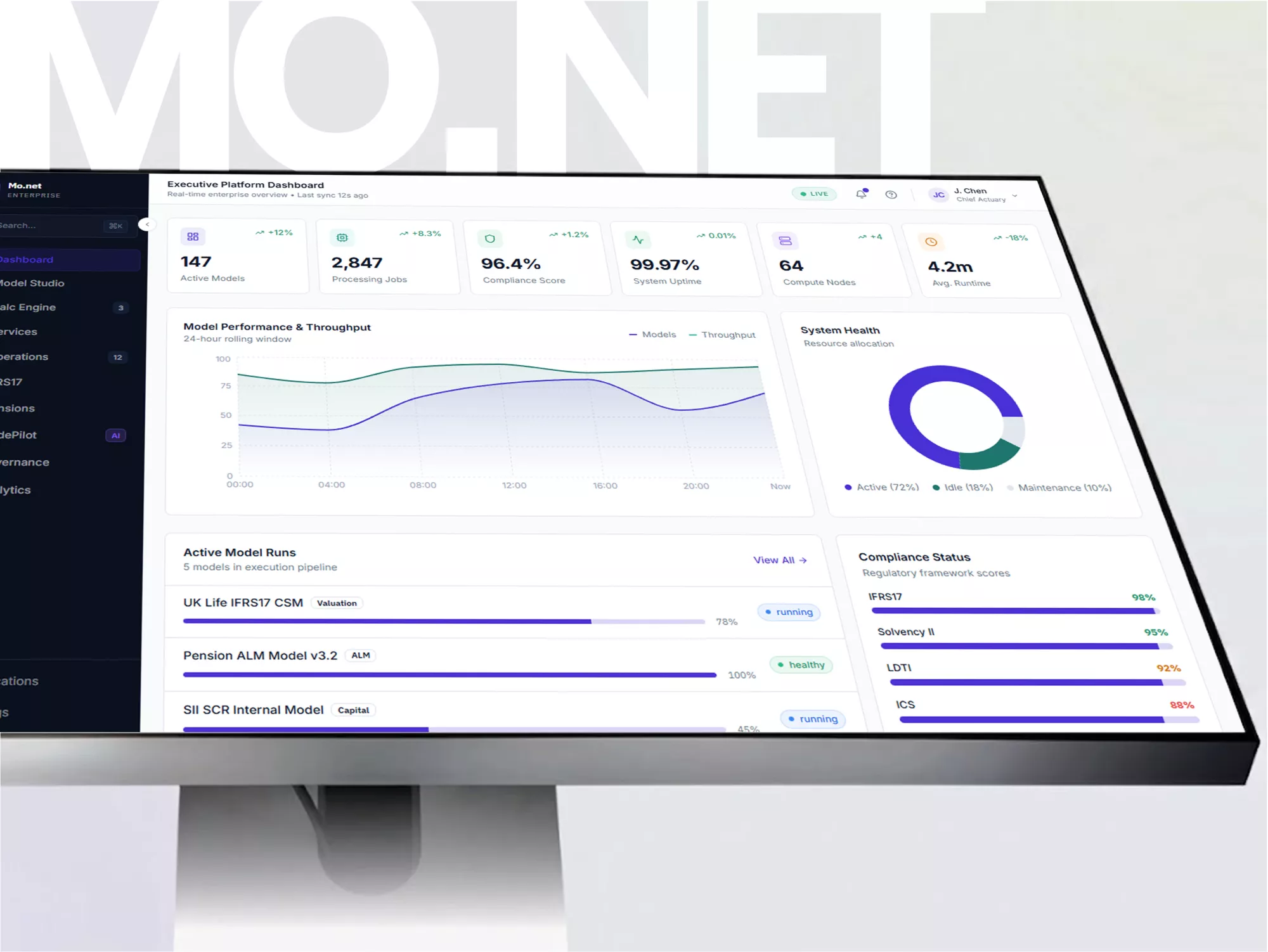
Mo.net is a financial modelling platform for insurance and pensions work. Actuarial models run on one calculation engine, with a studio for builders and enterprise services for quotations. Results from the delivery: 75% less modelling complexity, 65% faster development cycles, and 80% better regulatory reporting efficiency.
75%
Reduction in financial modelling complexity
65%
Faster model development cycles
80%
Improvement in regulatory reporting efficiency
3x
Faster enterprise model execution
The problem
Insurance and pensions modelling spans pricing, valuations, and regulatory packs. Without one engine, teams copy models between tools, lose debug history, and cannot run the same calculation in the studio and in operations.
A spreadsheet model does not give role-based access, API integration, or a 64-bit multi-threaded run. An opaque engine does not give modelers a studio with debugging and source control.
- Model development, execution, and operational quoting lived in separate stacks
- Industry packs such as pensions dashboards and IFRS 17 needed the same engine
- Cloud and on-premise delivery both had to stay in play
- No shared studio for debugging, profiling, and code generation
- Operational users needed a separate interface from model developers
- Governance, identity, and APIs were not first-class platform services
What we changed
We built and maintained Mo.net platform components for Software Alliance: the core calculation engine, Model Development Studio, enterprise services, and industry solutions including a pensions dashboard, IFRS 17, and CodePilot.
- Single calculation engine for insurance lifecycle modelling
- Model Development Studio with debugging and profiling
- Enterprise services for quotations, execution, and identity
- Cloud modelling services and on-premise deployment options
Modelers still own assumptions and sign-off. CodePilot can generate. A person still reviews before a production run or a regulatory pack.
What changed in the numbers
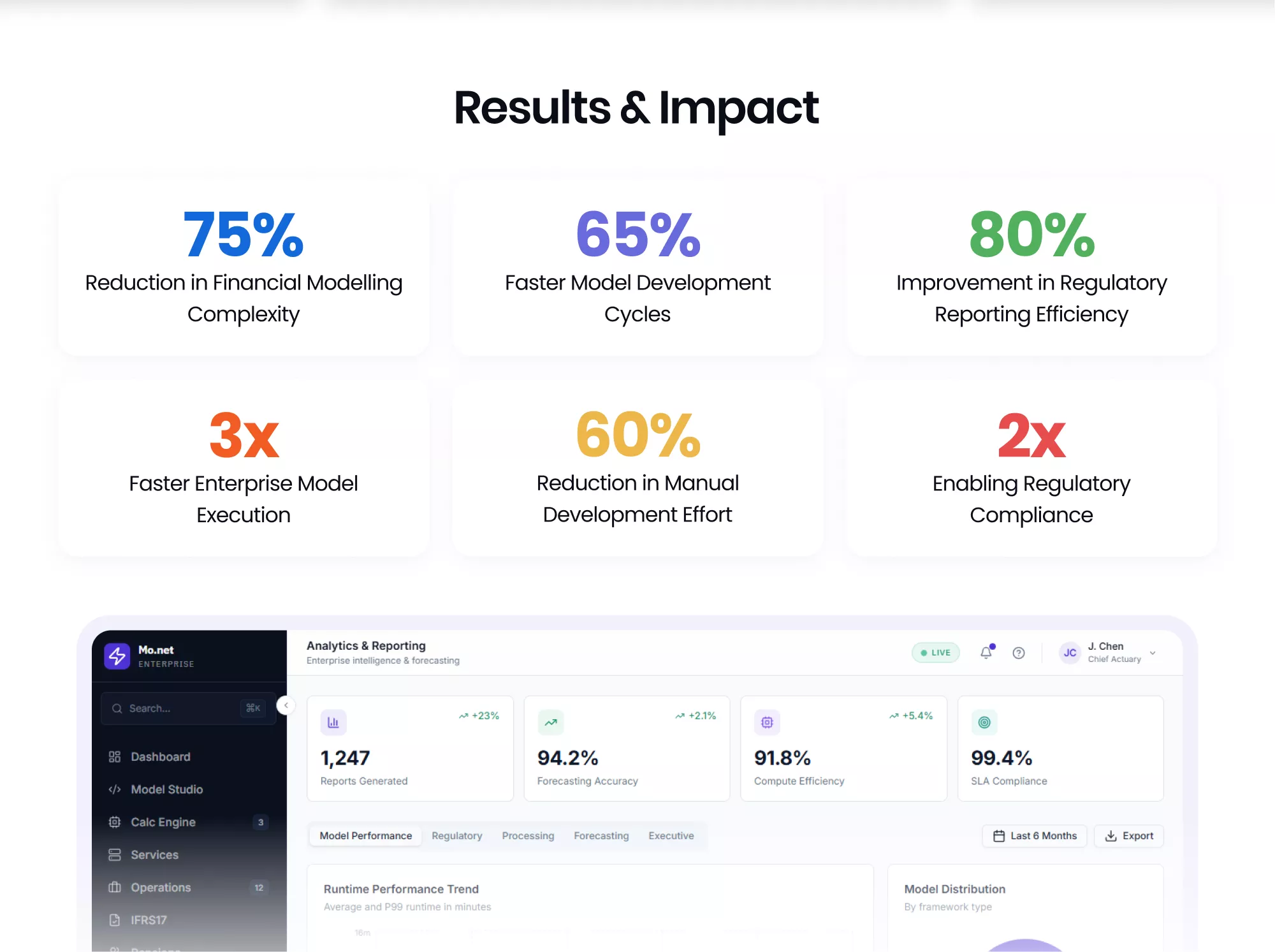
75%
Reduction in financial modelling complexity
65%
Faster model development cycles
80%
Improvement in regulatory reporting efficiency
3x
Faster enterprise model execution
Financial modelling complexity dropped 75%. Model development cycles are 65% faster, with 80% better regulatory reporting efficiency.
Software Alliance / Mo.net
What this means for you
- Financial modelling software only helps if studio and operations share one engine
- Code generation is useful after a person can debug the model, not instead of that
- Cloud and on-premise both matter for insurers who cannot move every workload
- Pensions and IFRS 17 packs should sit on the same engine as pricing, not a fork
Questions people ask
Insurance and pensions financial modelling. One calculation engine supports the model studio, operational runs, quotations, and industry packs such as a pensions dashboard and IFRS 17.
Yes. Cloud modelling services and on-premise deployments are both part of the platform, with API integration for surrounding systems.
Modelers still own assumptions and sign-off. Generated code and regulatory outputs need review before a production or filing run.
Ready for a similar result?
Short assessment
Book a short assessment
We look at one live workflow and tell you whether this pattern fits, before you add another tool.
See if this fits our operationSend a note
Talk through a similar workflow
Tell us about the job your team already does. Use the form at the bottom of this page. No new login.
Talk through a similar workflowHow it works
What we chose to automate
CodePilot and studio automation help modelers once the calculation engine is trusted. The first job is a governed engine people can debug, not a black-box forecast.
- Keep one engine from model studio through operational execution
- Use CodePilot for generation only where a modeler can still review the output
- Expose APIs so surrounding insurance systems do not re-implement the math
How the pieces fit together
A 64-bit multi-threaded engine sits behind the studio, operational modelling centre, and APIs. Role-based permissions and source control keep model change history next to the run.
- .NET and C# platform with API-based integration
- Operational Modelling Centre for end-user runs
- Role-based permissions and governance
- Source control integration for model assets
When a person still takes over
Modelers still own assumptions and sign-off. CodePilot can generate. A person still reviews before a production run or a regulatory pack.
- Studio debugging and profiling before operational execution
- Role-based access to quotations and identity services
- Human review on generated code and IFRS 17 outputs
What it connects to
- API-based integration with surrounding insurance systems
- Source control for model assets
- Cloud services and on-premise hosting
Insurance models still split between studio and operations?
If pricing, pensions, and IFRS 17 packs cannot share one engine, we can look at a governed modelling platform with a studio and operational services, the way we did on Mo.net.
RELATED WORK
Related case studies, services, and guides
SaaS Platforms
Learn moreWe help mature B2B SaaS teams add AI without destabilizing the product: embedded copilots, modernization layers, and framework upgrades for multitenant platforms built on .NET, ABP.IO, and ASP.NET Zero. AI retrofit for SaaS means governed automation inside the workflows you already run, with tenant boundaries, role based access, and audit trails. Whether your product serves staffing, HR, healthcare, or logistics operations, we integrate AI capabilities safely into workflow-heavy SaaS. IbisHR, Array Corp, and Workloop show multitenant proof in production.
SaaS Modernization and AI Retrofit
Learn moreModernize legacy SaaS platforms without full rewrites: framework upgrades, permission cleanup, and AI enablement layers. Extend platform lifespan with operational AI.
Legacy SaaS modernization review
Learn moreWe audit your underlying application architecture, database isolation patterns, and dependency chains on .NET, ABP.IO, or ASP.NET Zero. You receive a clear parallel-track plan that upgrades framework versions and injects governed AI capabilities into your core workflows without forcing a costly complete rebuild.
Axalio FinTech case study
Learn moreHow Axalio democratized investment management: 300% onboarding improvement and portfolio management reduced from hours to minutes.