


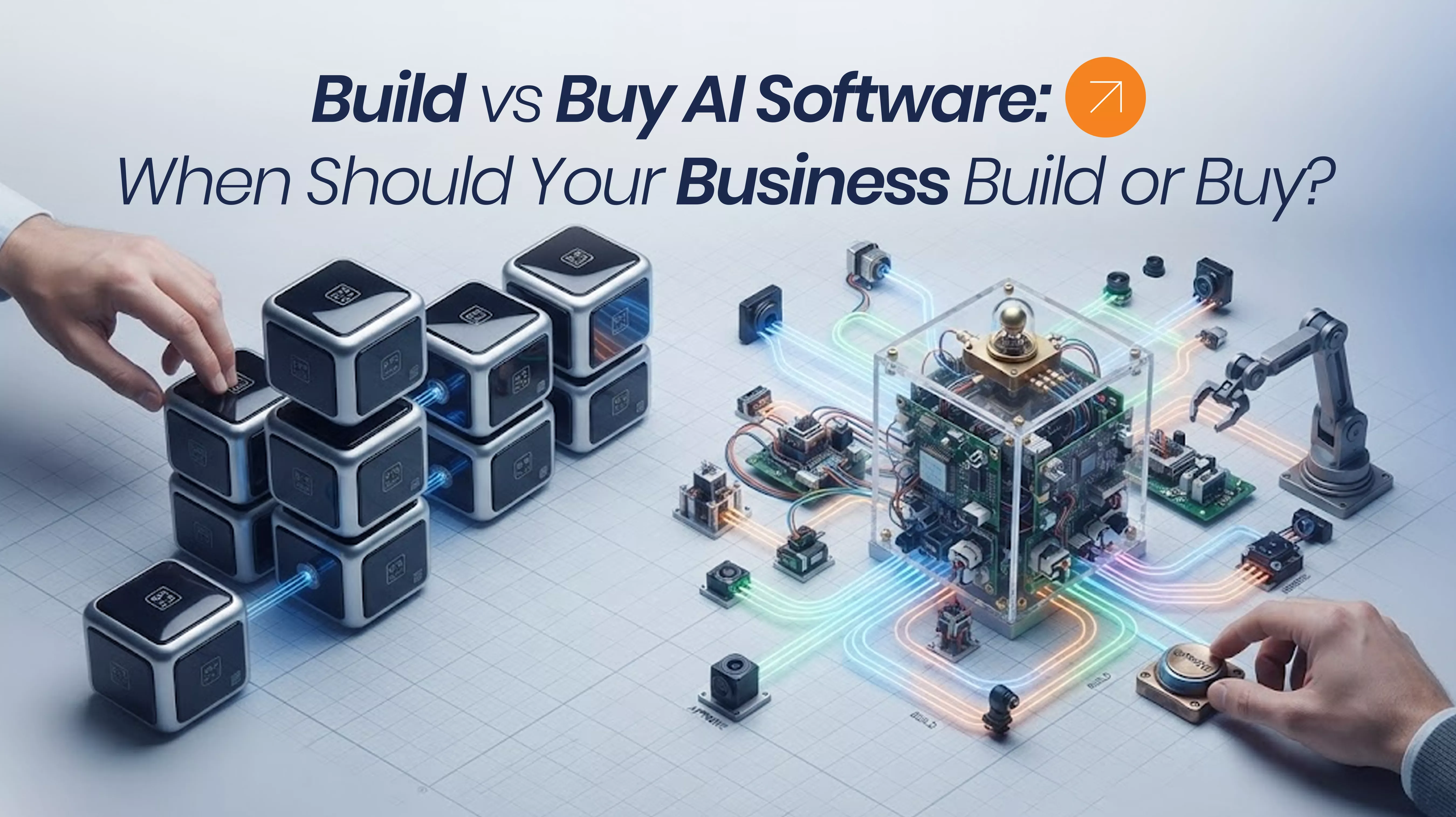
Should you buy an AI tool or build your own?
It sounds like a technology question.
Most of the time, it is actually a business decision.
A company already has a CRM. It has payroll software. It has a booking system. It has accounting software.
Then one workflow doesn't fit.
Employees export data. Someone checks it in a spreadsheet. Another person approves it over email. Someone else puts the result back into the original system.
Now the company is considering an AI solution.
The question becomes:
Do we buy another AI tool, or build something ourselves?
The answer isn't always one or the other.
For many businesses, the smarter approach is:
Buy the system. Build the part that makes your business different.
That's where custom software development, AI integration, and workflow automation can make more sense than replacing an entire system.
This guide explains how to approach the build vs buy AI software decision without turning it into a technical exercise.
Contents
- Key takeaways
- What "build vs buy" means for AI software
- Why the decision has changed
- What should you buy?
- What should you build?
- Don't build another AI chatbot just because you can
- Buy the system. Build the exception.
- When custom software development makes sense
- Five questions to ask before you build
- A simple build vs buy framework
- What this looks like in practice
- FAQ
- Conclusion
Key Takeaways
- Buy software when the problem is common and already solved well.
- Build when your workflow, rules, data, or customer experience are genuinely different.
- You usually don't need to build an AI model from scratch.
- The most valuable thing to build is often the workflow around AI, not the AI model itself.
- If employees still have to copy information between systems, the AI hasn't solved the whole problem.
- Custom software development becomes more valuable when the missing piece is part of your core business process.
- A good AI solution should have a clear owner, permission model, and way to review important actions.
What Does "Build vs Buy" Mean for AI Software?
The basic decision is simple.
Buying means:
You use an existing AI product or software platform.
Examples include:
- AI writing tools
- Customer service software
- CRM platforms
- AI meeting assistants
- Document processing tools
- AI chatbots
- AI productivity software
- AI agent platforms
You pay for the product and configure it for your business.
Building means:
You create software specifically around your company's workflow.
That might mean:
- Connecting AI to your existing software
- Creating a custom AI assistant
- Automating a business process
- Adding AI to an existing SaaS product
- Creating custom approval rules
- Connecting several systems
- Building an AI-powered feature for customers
You aren't necessarily building the AI model itself.
You are building the system around it.
That's an important distinction.
Why the Build vs Buy Decision Has Changed
For years, buying software was usually the easier answer.
Building required developers, infrastructure, maintenance, testing, and a large upfront investment.
AI has changed part of that equation.
Tools such as AI coding assistants, AI website builders, and agent platforms have made it much easier to create prototypes and internal tools. Ahrefs' 2026 research shows just how quickly this market has grown: "Claude Code" has reached around 508,000 US searches per month, "vibe coding" around 86,000, and "Cursor AI" around 83,000.
That doesn't mean every company should start building its own software.
It means the barrier to building a prototype is lower than it used to be.
But a prototype and a production system are very different things.
A useful demo can be built quickly.
A system that handles real customer data, permissions, errors, approvals, security, and ongoing maintenance is another matter.
That's why the real question isn't:
"Can we build this?"
It is:
"Should we own this part of the software?"
What Should You Buy?
Start with software that solves a problem shared by thousands of businesses.
If the process is standard and already works well, buying usually makes more sense.
Think about:
CRM
You probably don't need to build your own customer relationship management platform.
Payroll
Payroll rules, tax calculations, employee records, and payments are already handled by established products.
Accounting
Building accounting infrastructure from scratch rarely creates an advantage for a business whose real value lies somewhere else.
Email and communication
Email delivery, calendars, messaging, and similar infrastructure are usually better purchased than rebuilt.
AI model access
In many cases, businesses don't need to train their own foundation model.
They can use an existing model and focus their engineering effort on how that model works with their data and processes.
The principle is simple:
Don't build something just because you can.
Buy the parts that are already commodities.
Then spend your time on the parts that make your business different.
What Should You Build?
This is where the decision becomes more interesting.
Build when the problem isn't generic.
For example, your company may have a workflow that looks like this:
Customer data → AI analysis → Business rule → Human approval → Action → CRM update
A generic AI tool might handle the analysis.
But it may not understand:
- Your business rules
- Your approval structure
- Your customer data
- Your permissions
- Your internal processes
- What action should happen next
That missing layer may be worth building.
Build the exception.
Not the entire universe.
A custom solution could be as focused as:
One AI feature + one workflow + one integration + one approval process.
That's often more valuable than building an entire replacement platform. For the rewrite-or-not version of this choice, see AI retrofit vs a full rewrite.
Don't Build Another AI Chatbot Just Because You Can
This is one of the easiest traps to fall into.
A company buys AI software.
Someone creates another internal chatbot.
It looks impressive.
People use it for two weeks.
Then they go back to the software they already use.
Why?
Because the chatbot isn't where the work happens.
Imagine an employee needs to approve a customer request.
The current workflow is:
CRM → Copy information → AI chatbot → Get recommendation → Copy recommendation → Return to CRM → Update record
The chatbot may be intelligent.
The workflow is still inefficient.
Now compare that with:
CRM → AI recommendation → Employee reviews → Approve → CRM updates
Same AI.
Very different experience.
The difference is AI integration.
The AI is no longer another destination.
It's part of the existing workflow. See our guide to adding AI without a rewrite.
Buy the System. Build the Exception.
This is the simplest way to think about the build vs buy AI software decision.
Buy the system.
Use existing software for things that aren't unique to your business.
Build the exception.
Build the workflow your existing software cannot handle.
Connect the two.
Make the custom part work with the system your employees already use.
For example:
Buy: CRM
Build: Custom AI lead qualification workflow
Connect: AI recommendation → CRM record
Or:
Buy: HR platform
Build: Custom policy assistant
Connect: AI → existing employee records → approved answer
Or:
Buy: Booking platform
Build: AI voice assistant
Connect: Conversation → booking API → existing schedule
This approach can give you the benefits of existing software without forcing your business to adapt every process around a generic tool. For a cost-focused version of the same choice, see when to build custom software vs buy SaaS.
When Custom Software Development Makes Sense
Custom software development becomes more interesting when several of these are true:
1. Your workflow is unique
Your process is different enough that standard software forces people into workarounds.
2. Your data needs to stay connected
Employees shouldn't have to export customer or employee data just to use AI.
3. You need specific permissions
Not everyone should be able to let AI change a customer record, approve an employee request, or trigger an external action.
4. The process happens frequently
A small inefficiency repeated hundreds of times can become a significant operational cost.
5. The workflow gives you a competitive advantage
If the way you operate is part of what makes your business different, outsourcing that process to a generic tool may limit you.
6. Existing software gets you most of the way there
This is often the sweet spot.
You don't need a new platform.
You need the missing 20%.
That's where custom software development companies can add value through integration, automation, and targeted software development.
When Should You Just Buy?
Building isn't automatically better.
Buy when:
- The problem is common.
- Existing products already solve it well.
- Your process doesn't require much customization.
- The software isn't a competitive advantage.
- Your team doesn't have the capacity to maintain it.
- The cost of building exceeds the value of owning it.
- You need the solution quickly.
For example, if you need a standard project management tool, there may be little reason to build one.
If your business has a completely unique project workflow that affects how you deliver your product or service, the calculation changes.
The decision should be based on the business process, not the excitement around the technology.
The AI Model Is Not Always the Part You Need to Build
One common misunderstanding is:
"If we want custom AI, we need our own AI model."
Usually, that's not the first question.
The more important questions are:
What data should the AI access?
What can it do with that data?
Who can approve its actions?
Where does the result go?
What happens when it is wrong?
Can someone see what happened later?
For many businesses, the model can be purchased or accessed through an existing AI platform.
The custom work sits around it.
That's why AI integration can be more important than creating an AI model from scratch.
Five Questions to Ask Before You Build
Before approving an AI software project, ask these five questions.
01. What system already handles this job?
Name the actual product.
Don't say:
"It's somewhere in our technology stack."
Identify the CRM, HR platform, booking system, ERP, SaaS product, or internal application.
02. What exactly is missing?
Don't build because the existing product feels limited.
Identify the specific gap.
Is it:
- A missing AI feature?
- A manual approval?
- A data transfer?
- A customer-specific rule?
- An integration?
- A reporting problem?
- A workflow that takes too many steps?
The smaller the problem can be defined, the easier it is to decide what to build.
03. Can an existing tool already solve it?
Search the market before starting development.
If a reliable product already solves the problem and doesn't create new limitations, buying may be the better choice.
Building something that already exists isn't automatically innovation.
04. Where does the AI result go?
This question gets overlooked.
AI generates an answer.
Then what?
Does someone copy it?
Does it update a record?
Does a person approve it?
Does it trigger another workflow?
Does the customer see it?
The destination matters as much as the AI output.
05. What happens when the AI is wrong?
Every AI workflow needs an answer to this.
For low-risk tasks, the system may simply flag the result.
For customer-facing, financial, HR, healthcare, or other high-impact actions, you may need:
- Human approval
- Permission controls
- Audit logs
- Rollback
- Clear ownership
The goal isn't to make AI perfect.
It's to make the workflow safe enough to operate in the real world. For how we handle review in production, see human-in-the-loop workflows.
A Simple Build vs Buy Framework
| Question | Buy | Build |
|---|---|---|
| Is the problem common? | Usually | Rarely |
| Does a mature product already exist? | Usually | Only if it doesn't fit |
| Is the workflow unique? | Sometimes | Often |
| Does it require deep integration? | Sometimes | Often |
| Is it a competitive advantage? | Rarely | More likely |
| Do you need full control? | Limited | High |
| Do you have a team to maintain it? | Less important | Important |
| Is speed the priority? | Usually | Depends |
| Does AI need to act inside your existing software? | Integrate | Often build the missing layer |
This isn't a mathematical rule.
It's a starting point for the conversation.
What This Looks Like in Practice
Solvefy's own work illustrates why the distinction matters.
For IbisHR, AI capabilities were connected to HR records the organization already relied on rather than creating a separate HR system. The delivery reported around 60% less administrative work and around 95% self-service adoption within 90 days.
For AICO, the AI voice experience was placed on top of the existing medical transportation booking workflow. The scheduling engine remained in place while the AI helped with the interaction. The delivery reported approximately 75% lower call-handling load and around 98% scheduling accuracy.
The lesson isn't that every company needs custom AI software.
It's that the value often comes from putting AI into the workflow instead of creating another destination for employees to visit.
What to Leave Alone
Some ideas should stay ideas.
Don't build:
A second version of software you already use successfully
If your CRM works, don't rebuild a CRM just because you want AI.
A chatbot with no real workflow
If it can't access the right information or help complete the job, it may become another unused tool.
A custom AI model without a clear reason
Owning a model isn't the same as owning a useful business capability.
A pilot that only exists as a presentation
A good demo is not necessarily a good production system.
An automation nobody can explain
If no one knows who approved an action or why it happened, the workflow isn't ready for important business operations.
Frequently Asked Questions
Is it better to build or buy AI software?
Neither is automatically better.
Buy when an existing product solves a common problem well.
Build when the missing capability is specific to your business, requires deep integration, or affects an important workflow.
A hybrid approach is often practical: buy the core system and build the missing layer around it.
Should a small business build its own AI software?
Not necessarily.
Small businesses can often start with existing AI tools and SaaS products.
Custom development becomes more relevant when manual work, integrations, customer experience, or a unique business process creates a clear reason to build.
Should we build our own AI model?
Usually, that shouldn't be the starting point.
First determine whether the value comes from the model itself or from the workflow around it.
In many cases, an existing model combined with your data, business rules, integrations, and permissions can solve the actual problem.
What is the difference between AI software and AI integration?
AI software can be a standalone product.
AI integration means adding AI capabilities to the software and workflows your business already uses.
For many organizations, integration is more practical because employees don't need to learn another system.
How much does custom AI software cost?
There is no useful single price.
A small AI feature connected to an existing application is very different from building an entire SaaS product.
The cost depends on:
- Number of workflows
- Integrations
- Data requirements
- User roles
- Security requirements
- AI model usage
- Interface requirements
- Testing
- Ongoing maintenance
Start by defining the workflow before estimating the software.
Conclusion
Build vs buy AI software isn't about choosing between two sides.
It's about deciding which parts of the technology you should own.
Buy the systems that are already solved.
Use existing AI models when they are good enough.
Build the workflow that makes your business different.
Connect it to the software your team already trusts.
And don't build another AI tool just because building one is easier than it used to be.
The better question is:
What is the one part of our workflow that existing software still doesn't solve?
That may be the part worth building.
Buy the system. Build the exception. Make the two work together.
Buy the system. Build the exception.
If one workflow still lives in exports, spreadsheets, and email, that missing layer may be worth building. We help teams connect AI to the software people already use, instead of shipping another unused destination.